
ZHUCHENG KAITE INTELLIGENT EQUIPMENT ZHUCHENG KAITE INTELLIGENT EQUIPMENT
News
ClassifyNews
How can vacuum chopper improve product yield?
Source:本站 Time:2026/1/22 14:32:14 frequency:
Technical exploration of vacuum chopper to improve product yield
1、 Overview of the working principle of vacuum chopper
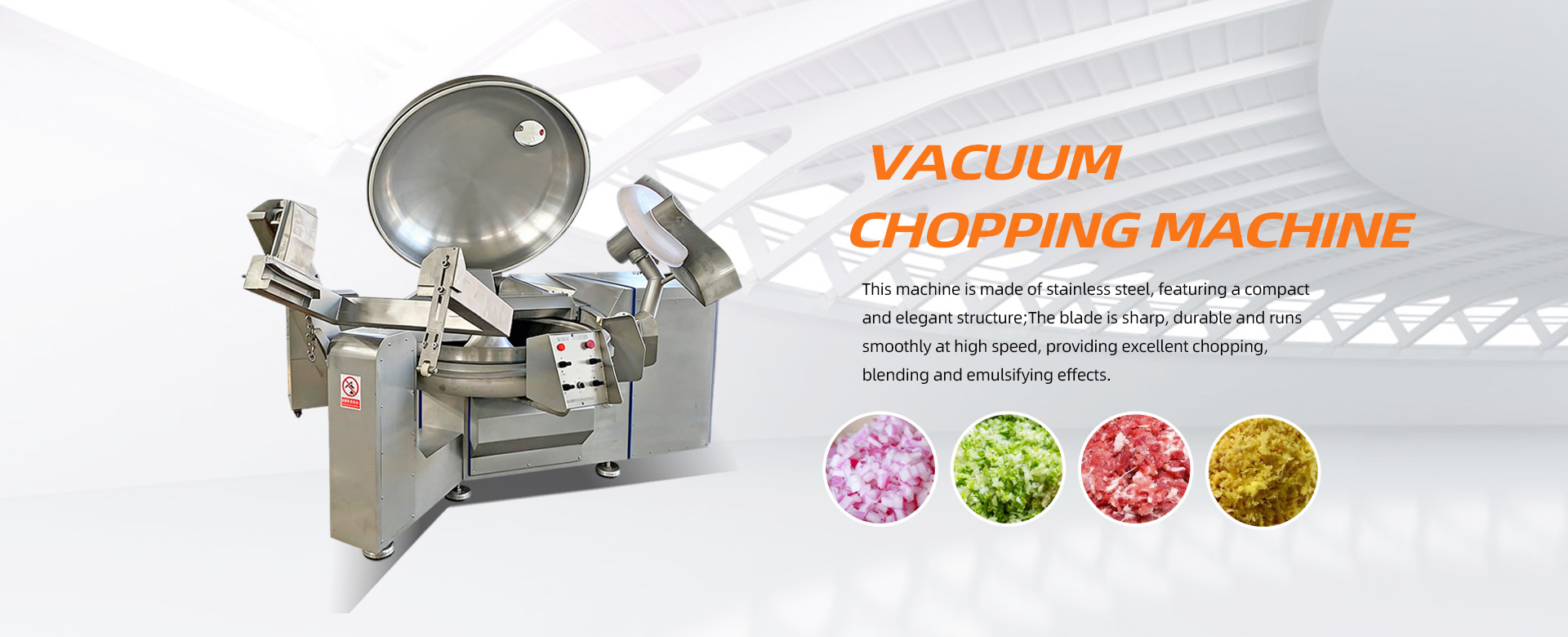
Vacuum chopper is a key equipment in the modern food processing industry, especially playing an important role in the fields of meat products, fish mince products, and plant protein processing. This device uses high-speed rotating blades to chop and mix raw materials, while operating in a vacuum environment, which can improve product quality and increase yield.
The basic workflow of a vacuum chopper includes: raw material input→ Vacuum pumping→ High speed chopping and mixing→ Emulsification→ Discharge. During this process, factors such as vacuum environment, cutting speed, temperature control, and time management collectively affect the yield of the final product.
2、 Analysis of key factors affecting yield
1. Vacuum degree control
Vacuum degree is one of the core parameters that affect yield. Appropriate vacuum treatment (usually maintained at 0.08-0.095MPa) can effectively remove air from the raw materials, prevent the formation of bubbles, and allow proteins to dissolve fully, forming a denser tissue structure. Experimental data shows that under the same conditions, vacuum cutting can increase the yield by 3-5% compared to atmospheric cutting.
2. Adjustment of cutting and mixing speed
The cutting speed is divided into three stages: low speed, medium speed, and high speed. The low-speed stage (1000-1500rpm) is mainly used for preliminary mixing of raw materials; Realize fine cutting in the medium speed stage (2000-3000rpm); The high-speed stage (3500-4500rpm) promotes sufficient protein extraction and emulsification. A reasonable speed gradient setting can ensure that the raw materials are fully crushed without damaging the protein structure, thereby improving water holding capacity and yield.
3. Temperature management
The frictional heat generated during the cutting and mixing process can increase the temperature of the material, and excessively high temperatures (generally not exceeding 12 ℃) can cause protein denaturation and reduce water holding capacity. By using a sandwich cooling system or adding ice flakes/ice water to control the temperature within the range of 4-8 ℃, the protein functional characteristics can be maximally maintained, and the yield can be increased by 1-2%.
4. Time control
A too short chopping time can lead to insufficient emulsification, while a too long time may damage the protein structure. According to the type of raw materials and formula, the total cutting time is usually controlled within 8-15 minutes, with high-speed cutting time accounting for about one-third. Time control can increase the yield by 0.5-1.5%.
3、 Specific technical measures to improve production rate
1. Optimization of raw material pretreatment
The pre-treatment of raw materials directly affects the cutting and mixing effect. Meat raw materials should be pre removed of fascia and connective tissue, and cut into small pieces of 3-5cm; Frozen raw materials need to be thawed to a center temperature of -2 to 0 ℃; Dry raw materials need to be fully rehydrated. Reasonable preprocessing can increase the yield by 2-3%.
2. Auxiliary material addition strategy
Adding phosphate (0.2-0.5%) can improve protein water holding capacity; Starch (3-8%) can increase viscosity and water retention; Soy protein (2-5%) can improve texture. These auxiliary materials are easier to mix evenly with the main material in a vacuum environment, synergistically increasing the yield by 4-8%.
3. Optimization of feeding sequence
The scientific order of adding ingredients is: meat→ Salt and phosphate→ 1/3 ice water→ Seasoning→ Remaining ice water→ Starch and other auxiliary materials. This phased addition method ensures that various components are fully emulsified, increasing the yield by 1-2%.
4. Vacuum holding technology
After cutting and mixing, maintaining a vacuum state for 2-3 minutes can make the product structure more compact, reduce moisture loss during subsequent heating processes, and increase yield by 0.5-1%.
4、 Comprehensive optimization of process parameters
1. Parameter matching scheme
Differentiated process parameters should be developed for different product types:
-Special meat products: high vacuum degree (above 0.09MPa), low cutting speed (high speed not exceeding 4000rpm), strictly controlled temperature (≤ 10 ℃)
-Ordinary meat products: Medium vacuum degree (0.08-0.085MPa), can increase the cutting speed appropriately, and the temperature control is relatively loose (12 ℃)
-Fish mince products: require higher chopping speed (up to 5000rpm), and the vacuum degree can be slightly lower (0.075-0.08MPa)
2. Process monitoring technology
Real time monitoring of parameters such as vacuum degree, temperature, and power consumption using modern sensing technology, and prediction of process points through the establishment of mathematical models. Research has shown that this dynamic optimization method can further increase the yield by 1-2%.
5、 Equipment maintenance and upkeep
1. Tool management
Keep the cutting tool sharp (check monthly, replace every 3-6 months), and control the gap between the blade tip and the cutting pot at 0.3-0.5mm. Blunt blades will increase cutting time, cause temperature rise, and reduce yield by 1-3%.
2. Maintenance of sealing system
Regularly inspect the vacuum sealing ring (quarterly) to ensure no leaks. Vacuum leakage can cause air to mix in, not only reducing the yield by 0.5-1.5%, but also affecting the texture of the product.
3. Maintenance of cooling system
Clean the cooling pipeline every month to ensure heat exchange efficiency. Insufficient cooling can cause a temperature increase of 2-3 ℃, resulting in a corresponding decrease of about 1% in yield.
6、 Prospects for the Application of Innovative Technologies
1. Pulse vacuum technology
Adopting intermittent vacuum pumping method (pumping for 30 seconds, stopping for 10 seconds) can promote intracellular water leakage, improve protein extraction rate, and preliminary experiments show that it can increase yield by 1.5-2%.
2. Ultrasonic assisted
Applying 20-40kHz ultrasound during the chopping process can damage the cell membrane structure, improve water holding capacity, and increase the yield by 2-3% under laboratory conditions.
3. Intelligent control system
The adaptive control system based on machine learning can automatically adjust process parameters according to the characteristics of raw materials, and is expected to improve the stability of yield by 30%, with an average yield increase of 0.5-1%.
VII. Conclusion
Improving the yield of vacuum chopper is a systematic project that requires optimization from multiple aspects such as equipment parameters, process control, raw material processing, and auxiliary material formula. By scientifically setting the vacuum degree, controlling the temperature and cutting parameters, and coordinating with standardized equipment maintenance, the product yield can be increased by 5-10%. In the future, with the application of new technologies such as pulse vacuum and ultrasonic assistance, the potential for improving the yield of vacuum cutting and mixing machines will be further explored. Food enterprises should establish a sound process management system, regularly maintain equipment and conduct process validation in order to continuously and stably obtain high-quality processed products.